The Effect of Centrifugation Test on the Physical Stability of Nanoemulsion Containing a Combination of Poloxamer 407, Tween 80, PEG 400, and DMSO
DOI:
https://doi.org/10.70075/jftsk.v3i1.272Keywords:
Nanoemulsion, Centrifugation, Physical stability, Tween 80, PEG 400Abstract
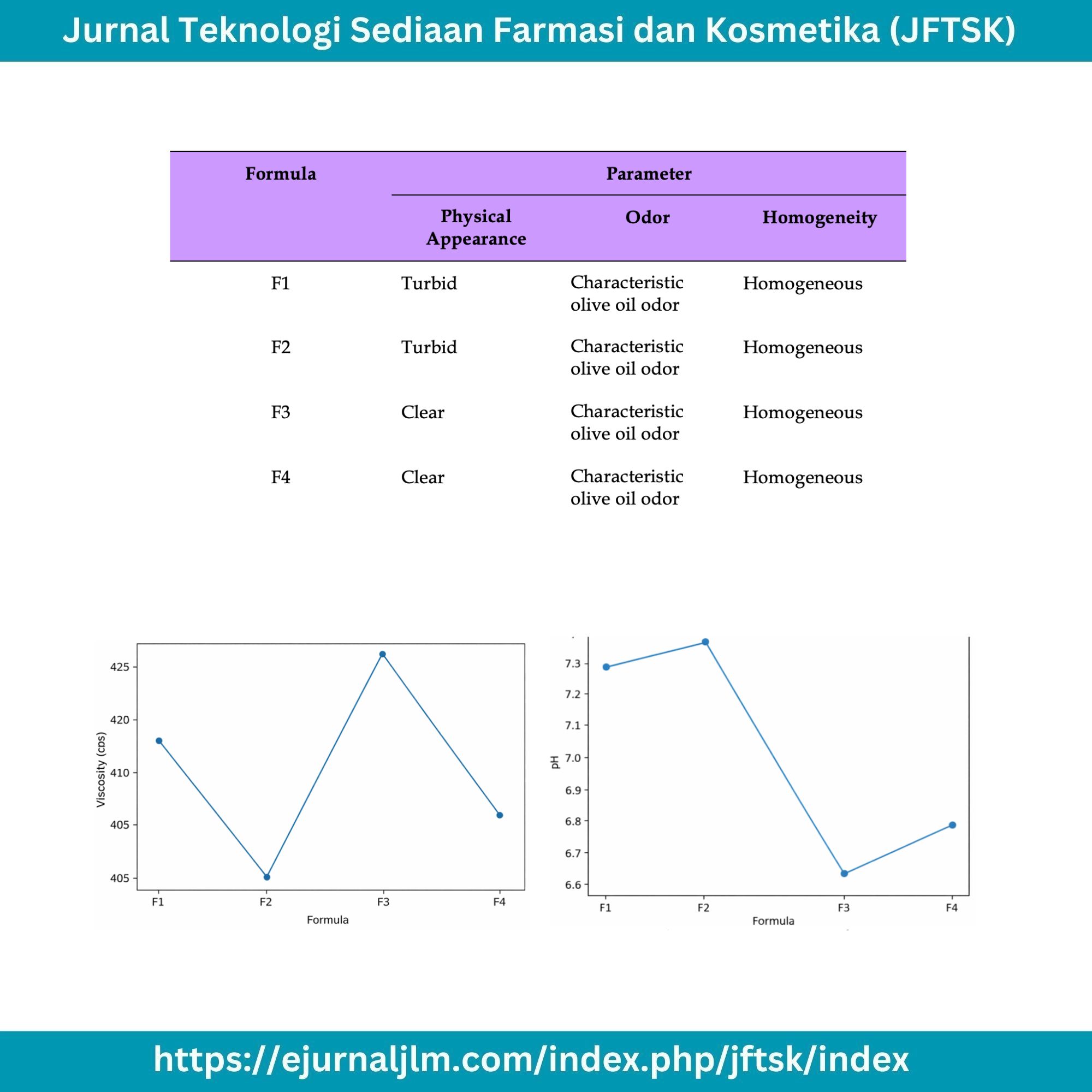
The development of nanoemulsion-based drug delivery systems has gained significant attention due to their ability to enhance drug solubility, stability, and therapeutic effectiveness. Optimizing the combination of surfactants, co-surfactants, and penetration enhancers is essential to produce a kinetically stable nanoemulsion system. This study aimed to formulate and evaluate the physical stability of nanoemulsions prepared using Tween 80, PEG 400, Poloxamer 407, and dimethyl sulfoxide (DMSO), and to determine the optimal formulation based on physicochemical characteristics and accelerated stability testing. Four nanoemulsion formulations (F1–F4) were prepared with varying concentrations of surfactant and co-surfactant. The formulations were evaluated for organoleptic properties, emulsion type, pH, viscosity, and physical stability using a centrifugation test at speeds up to 8000 rpm to detect phase separation, flocculation, or coalescence. The results showed that all formulations were classified as oil-in-water (o/w) nanoemulsions. No phase separation was observed after centrifugation, indicating good physical stability. However, F1 and F2 appeared turbid, whereas F3 and F4 demonstrated better clarity and overall stability. The pH values ranged from 6.6 to 7.4, which are acceptable for topical application, and viscosity values ranged from 405 to 427 cPs, indicating suitable rheological properties for topical use. In conclusion, the combination of Tween 80, PEG 400, Poloxamer 407, and DMSO successfully produced a kinetically stable nanoemulsion system. Among the tested formulations, F3 and F4 exhibited the most optimal characteristics and show strong potential for further development in pharmaceutical nanoemulsion formulations.
Downloads
References
McClements DJ. Nanoemulsions versus microemulsions: Terminology, differences, and similarities. Soft Matter. 2012;8(6):1719–29.
Gupta A, Eral HB, Hatton TA, Doyle PS. Nanoemulsions: Formation, properties and applications. Soft Matter. 2016;12(11):2826–41.
Anton N, Vandamme TF. Nano-emulsions and micro-emulsions: Clarifications of the critical differences. Pharm Res. 2011;28(5):978–85.
Zhao S, Wang Z, Wang X, Kong B, Liu Q, Xia X, et al. Characterization of nanoemulsions stabilized with different emulsifiers and their encapsulation efficiency for oregano essential oil: Tween 80, soybean protein isolate, tea saponin, and soy lecithin. Foods. 2023;12(17):3183.
Zhang Z, Liu Y, Liu J, Chen Y, Wu C. Accelerated stability testing of nanoemulsions using centrifugation and temperature stress methods. Colloid Polym Sci. 2018;296(6):1045–55.
Solans C, Morales D, Homs M. Spontaneous emulsification. Curr Opin Colloid Interface Sci. 2016;22:88–93.
Jaiswal M, Dudhe R. Nanoemulsion : an advanced mode of drug delivery system. 2015;123–7.
Komaiko J, McClements DJ. Formation of food-grade nanoemulsions using low-energy preparation methods: A review of available methods. Food Hydrocoll. 2016;42:118–28.
Chung EP, Wells AR, Kiamco MM, Leung KP. Dual Asymmetric Centrifugation Efficiently Produces a Poloxamer-Based Nanoemulsion Gel for Topical Delivery of Pirfenidone. AAPS PharmSciTech. 2020;21(7):1–11.
Ahmad A, El-Gendy AO, Alhadidi Q, Alkhateeb MA. The importance of olive oil in human nutrition and health: A review. Int J Nutr Food Sci. 2022;11(3):45–53.
Tungadi R, Paneo M, Nurkamiden F. Pengembangan Teknik Matriks Patch Alpha Arbutin Berbasis Nanoemulsi dan Uji Permeasi secara In Vitro. J Farm Teknol Sediaan dan Kosmet. 2024 Jul 31;1:53–63.
Tungadi R, Thomas NA, Hasan H, Taupik M, Pakaya JJ. Uji Permeasi Nanoemulgel Kurkumin Secara In Vitro. 2024;1:91–103.
Kariem N, Djuwarno EN, Latif MS. Physical Stability Test of Liquid Soap Preparation from Avocado Seed Oil ( Persea americana Mill .). 2025;2:130–41.
Indalifiany A, Malaka MH, Sahidin, Fristiohady A, Andriani R. Jurnal Farmasi Sains dan Praktis formulasi dan uji stabilitas fisik nanoemulgel formulation and physical stability test of nanoemulgel containing Petrosia Sp . 2021;7(3):321–31.
Gusnasi D, Taufiq R, Baharta E. Uji Oranoleptik Dan Daya Terima Pada Produk Mousse Berbasis Tapai Singkong Sebegai Komoditi Umkm Di Kabupaten Bandung. J Inov Penelit. 2021;1(12):2883–8.
Nailufa YN. The Optimization of Cream Body Scrub with Black Rice Extract and Aloe Vera Extract. J Herbal, Clin Pharm Sci. 2024;5(02):139.
Jaiswal M, Dudhe R, Sharma PK. Nanoemulsion: an advanced mode of drug delivery system. 3 Biotech. 2015;5(2):123–7.
Kumar R, Soni GC, Prajapati SK. Formulation development and evaluation of Telmisartan Nanoemulsion. Int J Res Dev Pharm Life Sci Int J Res Dev Pharm Life Sci. 2017;6(4):2711–9.
Ryu V, McClements DJ. Influence of surfactant–cosurfactant interactions on the formation and stability of nanoemulsions. Langmuir. 2020;36(10):2570–80.
Li PH, Chiang BH. Process optimization and stability of D-limonene-in-water nanoemulsions prepared by ultrasonic emulsification using response surface methodology. Ultrason Sonochem. 2012;19(1):192–7.
Subramaniyan V, Thenmozhi M, Vijayalakshmi R, Thiruvengadam D. Investigation on stability and particle size of nanoemulsions under different stress conditions. Int J Pharm Sci Rev Res. 2019;55(1):47–53.
Aswathanarayan JB, Vittal RR. Nanoemulsions for delivery of lipophilic nutraceuticals: A review. Crit Rev Food Sci Nutr. 2019;59(21):3155–68.
Rahman MM, Akter S, Hasnain MS, Beg S. Recent advances in nanoemulsion-based drug delivery systems: A review. J Drug Deliv Sci Technol. 2021;66:102915.
Kaur P, Garg T, Rath G, Goyal AK. Optimization of nanoemulsion system for transdermal delivery of domperidone using response surface methodology. J Pharm Investig. 2016;46(6):463–76.
Downloads
Published
How to Cite
Issue
Section
License
Copyright (c) 2026 Rani Orelia A. Unga, Teti Sutriyati Tuloli, Mohamad Aprianto Paneo, La Ode Aman, Mohamad Adam Mustapa

This work is licensed under a Creative Commons Attribution-ShareAlike 4.0 International License.