Optimization of a Niosomal Transdermal Delivery System Containing Kojic Acid and Alpha Arbutin
DOI:
https://doi.org/10.70075/jftsk.v3i2.569Keywords:
Kojic acid, alpha-arbutin, niosomes, transdermal delivery, Span 80.Abstract
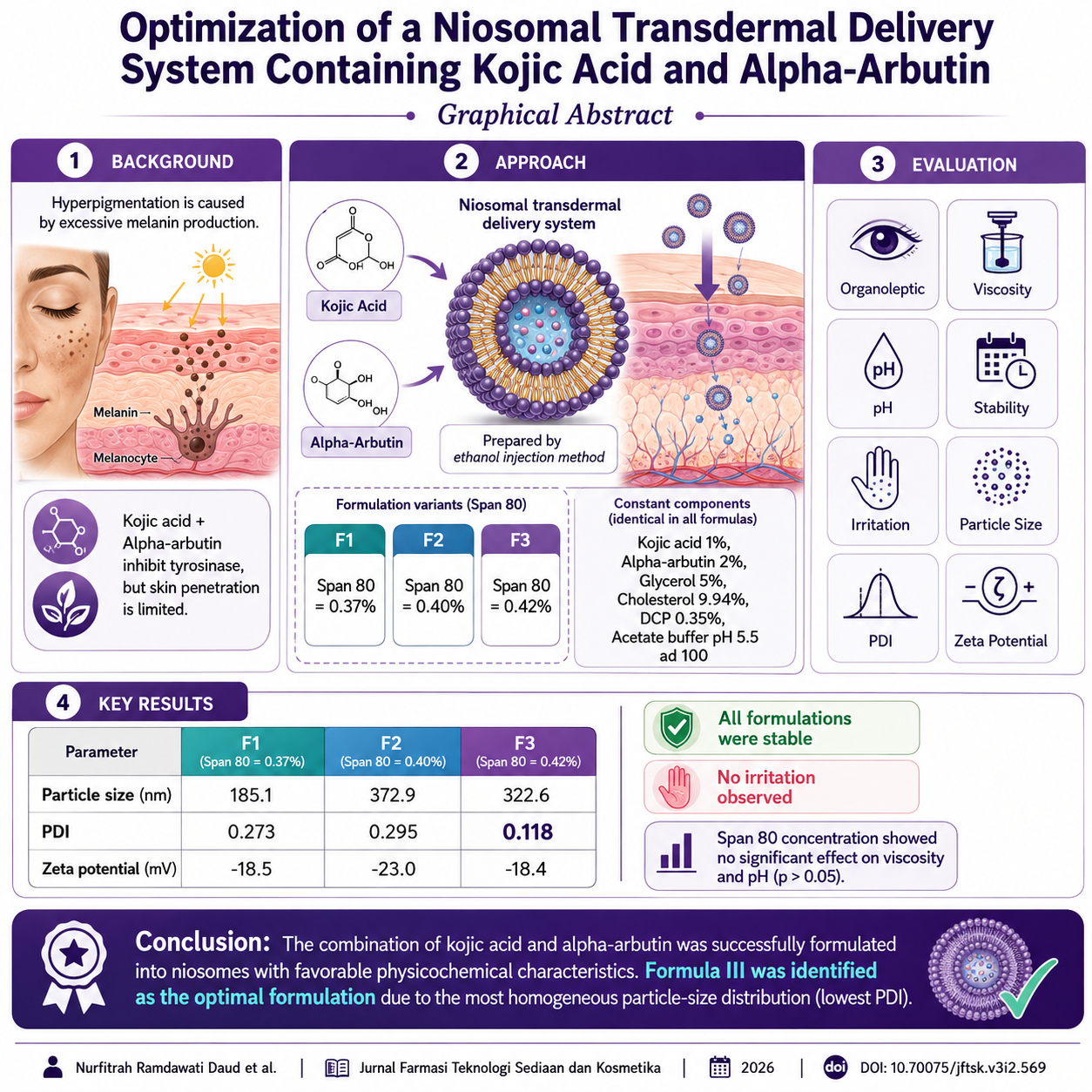
Hyperpigmentation is a skin disorder characterized by excessive melanin production. Kojic acid and alpha-arbutin are skin-lightening agents that inhibit tyrosinase activity; however, their effectiveness is limited by poor skin penetration. This study aimed to formulate and characterize a niosomal transdermal delivery system containing a combination of kojic acid and alpha-arbutin at different Span 80 concentrations. Niosomes were prepared using the ethanol injection method in three formulations: F1 (0.37% Span 80), F2 (0.40% Span 80), and F3 (0.42% Span 80). The formulations were evaluated for organoleptic properties, viscosity, pH, stability, irritation potential, particle size, polydispersity index (PDI), and zeta potential. All formulations exhibited acceptable physical characteristics, remained stable, and caused no irritation. The particle sizes of F1, F2, and F3 were 185.1 nm, 372.9 nm, and 322.6 nm, respectively, with corresponding PDI values of 0.273, 0.295, and 0.118. The zeta potential values were -18.5 mV, -23.0 mV, and -18.4 mV for F1, F2, and F3, respectively. Statistical analysis showed that variation in Span 80 concentration had no significant effect on viscosity or pH (p > 0.05). The combination of kojic acid and alpha-arbutin was successfully incorporated into a niosomal system with favorable physicochemical characteristics, and Formula III was identified as the optimal formulation.
Downloads
References
H. Widiowati and E. Rinata, Buku Ajar Anatomi, S. M. F. Hanum, Ed., UMSIDA Press, 2020.
Z. Mustafidah and A. Utami, Sistem Pakar Identifikasi Masalah Kulit Wajah Menggunakan Metode Case Based Reasoning, Jurnal Komtika (Komputasi dan Informatika), vol. 8, no. 2, pp. 190–199, Nov. 2024, doi: 10.31603/komtika.v8i2.11614.
S. Tazesh, E. Tamizi, M. S. Shadbad, N. Mostaghimi, and F. Monajjemzadeh, Comparative Stability of Two Anti-hyperpigmentation Agents: Kojic Acid as a Natural Metabolite and Its Di-Palmitate Ester, Under Oxidative Stress; Application to Pharmaceutical Formulation Design, Adv. Pharm. Bull., vol. 12, no. 2, pp. 329–335, 2022, doi: 10.34172/apb.2022.031.
R. Tungadi, M. A. Paneo, and F. Nurkamiden, Pengembangan Teknik Matriks Patch Alpha Arbutin Berbasis Nanoemulsi dan Uji Permeasi secara In Vitro, Jurnal Farmasi Teknologi Sediaan dan Kosmetika, vol. 1, no. 2, pp. 53–63, Jul. 2024, doi: 10.70075/jftsk.v1i2.52.
S. M. Mawazi, Y. Ge, and R. T. Widodo, Niosome Preparation Techniques and Structure—An Illustrated Review, Jan. 01, 2025, Multidisciplinary Digital Publishing Institute (MDPI). doi: 10.3390/pharmaceutics17010067.
L. Antonara et al., Recent advances in niosome-based transdermal drug delivery systems, Sep. 01, 2025, Elsevier B.V. doi: 10.1016/j.cobme.2025.100603.
B. A. Witika and R. B. Walker, Preformulation characterization and identification of excipients for nevirapine loaded niosomes, Pharmazie, vol. 76, no. 2–3, pp. 77–83, Feb. 2021, doi: 10.1691/ph.2021.0137.
L. Pavčnik, M. Prunk, T. Trdan Lušin, and R. Roškar, Accelerated Predictive Stability Testing: Accelerating Registration Phase and Application of Reduced Designs for Shelf-Life Determination of Parenteral Drug Product, Pharmaceutics, vol. 17, no. 2, Feb. 2025, doi: 10.3390/pharmaceutics17020160.
D. Ag Seleci, M. Seleci, J. G. Walter, F. Stahl, and T. Scheper, Niosomes as nanoparticular drug carriers: Fundamentals and recent applications, 2016, Hindawi Limited. doi: 10.1155/2016/7372306.
P. Kaur, Muskan, and P. Kriplani, Quality by design for niosome-based nanocarriers to improve transdermal drug delivery from lab to industry, International Journal of Pharmaceutics, vol. 666, art. 124747, Dec. 2024, doi: 10.1016/j.ijpharm.2024.124747.
Y. Khadivi, S. Shakeri, S. Arjmandmazidi, J. Shokri, and F. Monajjemzadeh, The effect of emulgel preparation on the stability of kojic acid in topical anti-hyperpigmentation products, Journal of Cosmetic Dermatology, vol. 23, no. 6, pp. 2145-2155, Jun. 2024, doi: 10.1111/jocd.16254.
Z. Li, M. Marlow, D. Scurr, and Z. Zhu, Targeted intradermal delivery of alpha-arbutin-loaded dissolving polymeric microneedles visualized by three-dimensional Orbitrap secondary ion mass spectrometry (3D OrbiSIMS), European Journal of Pharmaceutics and Biopharmaceutics, vol. 196, art. 114181, Mar. 2024, doi: 10.1016/j.ejpb.2024.114181.
Z. Li et al., The molecular mechanisms underlying optical isomer arbutin permeating the skin: The molecular interaction between arbutin and skin components, International Journal of Pharmaceutics, vol. 664, art. 124584, Oct. 2024, doi: 10.1016/j.ijpharm.2024.124584.
S. Hatem, A. O. Kamel, S. A. Elkheshen, M. Nasr, N. H. Moftah, M. H. Ragai, N. M. El Hoffy, and R. S. Elezaby, Nano-vesicular systems for melanocytes targeting and melasma treatment: In-vitro characterization, ex-vivo skin retention, and preliminary clinical appraisal, International Journal of Pharmaceutics, vol. 665, art. 124731, Nov. 2024, doi: 10.1016/j.ijpharm.2024.124731.
A. Z. Alkilani, Z. Sharaire, R. Hamed, and H. A. Basheer, Transdermal delivery system of doxycycline-loaded niosomal gels: Toward enhancing doxycycline stability, ACS Omega, vol. 9, no. 31, pp. 33542-33556, Jul. 2024, doi: 10.1021/acsomega.4c01224.
Downloads
Published
How to Cite
Issue
Section
License
Copyright (c) 2026 Nurfitrah Daud, Mahdalena Sy Pakaya, Faradila Ratu Cindana Mo’o, Faramita Hiola, La Ode Aman

This work is licensed under a Creative Commons Attribution-ShareAlike 4.0 International License.