Evaluation of the Physical Stability of a Grape Seed Oil Nanoemulsion Base Using a Centrifugation Test
DOI:
https://doi.org/10.70075/jftsk.v3i2.302Keywords:
nanoemulsion, centrifugation test, Poloxamer 407, Transcutol HP, Physical stability, grapeseed oilAbstract
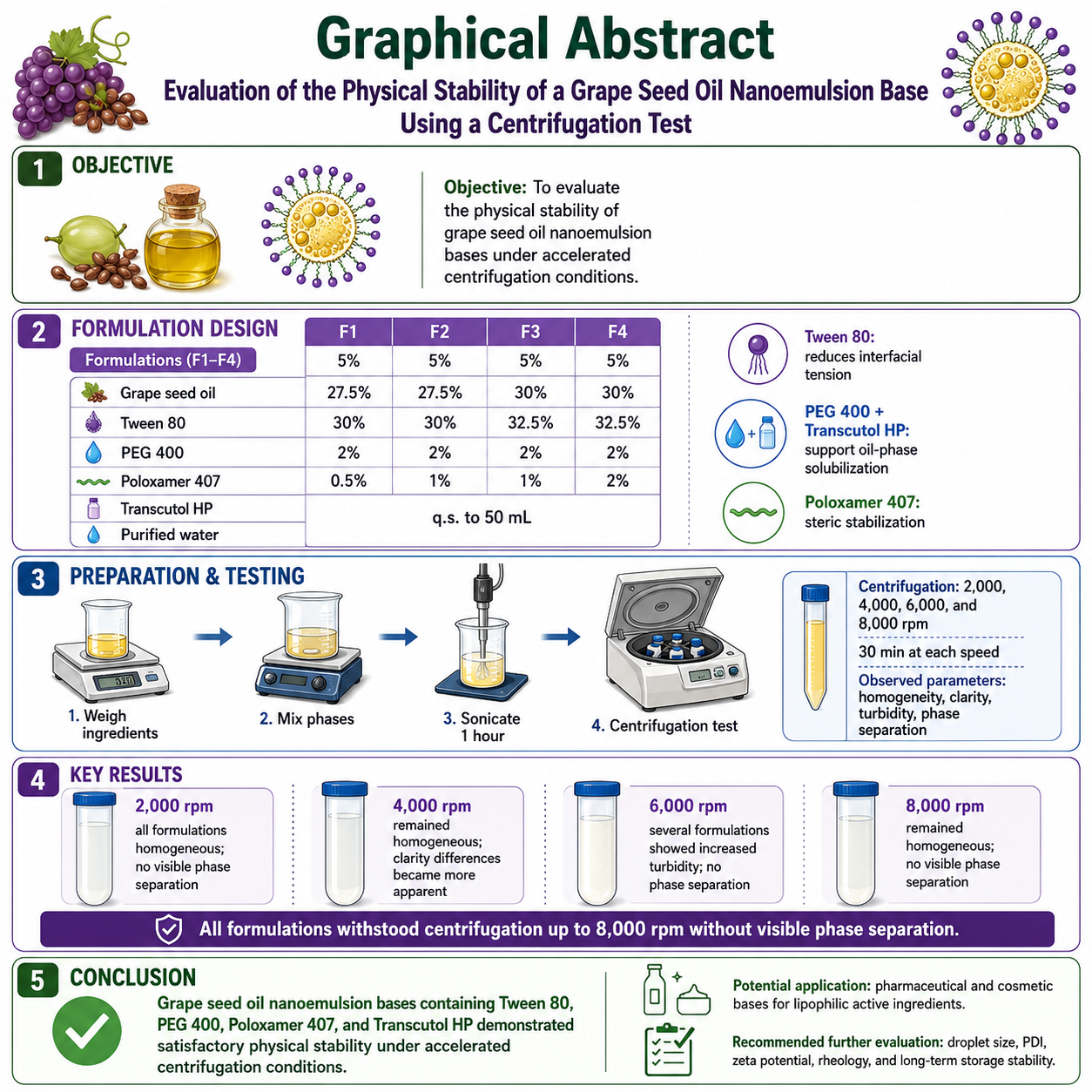
Nanoemulsions are nanometer-scale dispersion systems used as bases for pharmaceutical and cosmetic preparations because they can improve the solubilization and physical stability of lipophilic ingredients. This study evaluated the physical stability of a grape seed oil nanoemulsion base containing Tween 80, PEG 400, Poloxamer 407, and Transcutol HP using an accelerated centrifugation test. Four formulations with different surfactant and co-surfactant concentrations were prepared and centrifuged at 2,000, 4,000, 6,000, and 8,000 rpm. Homogeneity, clarity, turbidity, and phase separation were assessed visually after each treatment. All formulations remained homogeneous without visible phase separation at 2,000 and 4,000 rpm. At 6,000 rpm, several formulations showed increased turbidity but no phase separation. At 8,000 rpm, the formulations remained homogeneous and showed no visible phase separation. The stability of the system may be associated with Tween 80 reducing interfacial tension, PEG 400 and Transcutol HP supporting solubilization of the oil phase, and Poloxamer 407 providing steric stabilization. These results demonstrate satisfactory physical stability under the applied centrifugation conditions and support further evaluation through droplet-size analysis, polydispersity index, zeta potential, rheology, and long-term storage studies.
Downloads
References
Singh Y, Meher JG, Raval K, Khan FA, Chaurasia M, Jain NK, Chourasia MK. Nanoemulsion: concepts, development and applications in drug delivery. J Control Release. 2017;252:28-49. doi:10.1016/j.jconrel.2017.03.008.
Gupta A, Eral HB, Hatton TA, Doyle PS. Nanoemulsions: formation, properties, and applications. Soft Matter. 2016;12:2826-2841. doi:10.1039/C5SM02958A.
Tadros T, Izquierdo P, Esquena J, Solans C. Formation and stability of nano-emulsions. Adv Colloid Interface Sci. 2004;108-109:303-318. doi:10.1016/j.cis.2003.10.023.
McClements DJ. Nanoemulsions versus microemulsions: terminology, differences, and similarities. Soft Matter. 2012;8:1719-1729. doi:10.1039/C2SM06903B.
Liu Q, Huang H, Chen H, Lin J, Wang Q. Food-grade nanoemulsions: preparation, stability and application in encapsulation of bioactive compounds. Molecules. 2019;24(23):4242. doi:10.3390/molecules24234242.
Steiner BM, Shukla V, McClements DJ, Li YO, Sancho-Madriz M, Davidov-Pardo G. Encapsulation of lutein in nanoemulsions stabilized by resveratrol and Maillard conjugates. J Food Sci. 2019;84(9):2421-2431. doi:10.1111/1750-3841.14751.
Shawahna R. Effects of a grapeseed oil (Vitis vinifera L.) loaded dermocosmetic nanoemulgel on biophysical parameters of facial skin: a split-face, blinded, placebo-controlled study. J Cosmet Dermatol. 2022;21(11):5730-5738. doi:10.1111/jocd.15161.
Gerber M, Oosthuysen E, van Jaarsveld JR, Shahzad Y, du Plessis J. Grapeseed oil nanoemulsions and nanoemulgels for transdermal delivery of a series of statins. J Drug Deliv Sci Technol. 2023;88:104900. doi:10.1016/j.jddst.2023.104900.
Shakeel F, Haq N, Alanazi FK, Alsarra IA. Impact of various nonionic surfactants on the efficiency of two-stage nanoemulsification of Capryol (Capryol-90 and Capryol-PGMC). J Mol Liq. 2013;182:57-63. doi:10.1016/j.molliq.2013.03.011.
Han H, Li Y, Peng Z, Long K, Zheng C, Wang W, et al. A Soluplus/Poloxamer 407-based self-nanoemulsifying drug delivery system for the weakly basic drug carvedilol to improve its bioavailability. Nanomedicine. 2020;27:102199. doi:10.1016/j.nano.2020.102199.
Felipe LO, Bicas JL, Changwatchai T, Abah EO, Nakajima M, Neves MA. Physical stability of alpha-terpineol-based nanoemulsions assessed by direct and accelerated tests using photocentrifugation analysis. LWT. 2024;205:116513. doi:10.1016/j.lwt.2024.116513.
Komaiko JS, McClements DJ. Formation of food-grade nanoemulsions using low-energy preparation methods: a review of available methods. Compr Rev Food Sci Food Saf. 2016;15(2):331-352. doi:10.1111/1541-4337.12189.
Li PH, Chiang BH. Process optimization and stability of d-limonene nanoemulsions in water prepared by ultrasonic emulsification using response surface methodology. Ultrason Sonochem. 2012;19(1):192-197. doi:10.1016/j.ultsonch.2011.05.017.
Algahtani MS, Ahmad MZ, Ahmad J. Investigation of factors affecting nanoemulsion formation via spontaneous emulsification: impact on droplet size, polydispersity index, and stability. Bioengineering. 2022;9(8):384. doi:10.3390/bioengineering9080384.
Rahmola F, Mustapa MA, Paneo MA, Djuwarno EN, Taupik M. Effect of centrifugation on the stability of nanoemulsions with Tween, PEG, Poloxamer 188, and Transcutol-p. Journal of Pharmaceutical Technology, Preparations, and Cosmetics. 2026;3(1):1-14. doi:10.70075/jftsk.v3i1.271.
Downloads
Published
How to Cite
Issue
Section
License
Copyright (c) 2026 Yaya Lakoro, Teti Sutriyati Tuloli, Mohamad Aprianto Paneo, Robert Tungadi, Ariani H Hutuba

This work is licensed under a Creative Commons Attribution-ShareAlike 4.0 International License.