Effect of Centrifugation on the Stability of Nanoemulsion Base Containing Tween 80, PEG 400, Poloxamer 188, and DMSO
DOI:
https://doi.org/10.70075/jftsk.v3i1.277Keywords:
Nanoemulsion, Centrifugation, Physical stability, Tween 80, PEG 400, Poloxamer 188Abstract
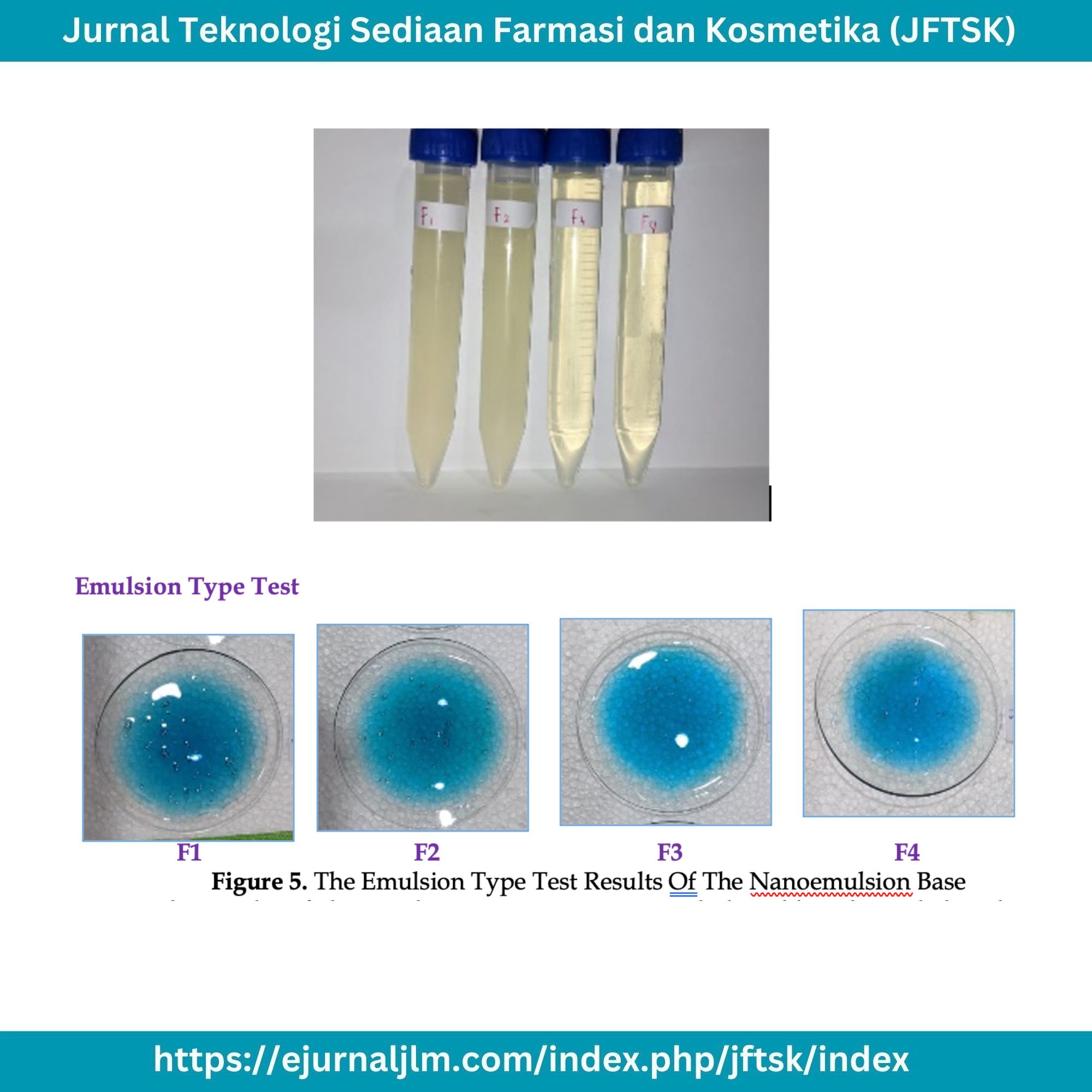
Nanoemulsions are biphasic dispersion systems (oil and water) with nanometer-scale droplet sizes that exhibit better physical stability than conventional emulsions and are widely utilized in pharmaceutical and cosmetic applications. The kinetic stability of nanoemulsions is strongly influenced by the composition of surfactants, co-surfactants, and other supporting components. This study aimed to evaluate the effect of centrifugation on the physical stability of an olive oil–based nanoemulsion with varying concentrations of Tween 80 and PEG 400, supported by Poloxamer 188 and DMSO. This laboratory-based experimental study employed the aqueous titration method for nanoemulsion preparation, followed by ultrasonication for 60 minutes. Accelerated stability testing was conducted through centrifugation at speeds of 2,000, 4,000, 6,000, and 8,000 rpm for 30 minutes. Physical evaluations included organoleptic testing, pH measurement, viscosity determination, and emulsion type identification using the methylene blue dye method. The results showed that all formulations remained stable at 2,000–4,000 rpm. At 6,000 rpm, formulations F1 and F2 began to exhibit partial creaming, and at 8,000 rpm significant phase separation was observed in F1 and F2, whereas F3 and F4 remained clear and homogeneous. The pH values of all formulations ranged from 6.8 to 7.3 (7.03 ± 0.22), indicating good chemical stability. Viscosity values ranged from 103 to 132 cPs (111.5 ± 13.77), which fall within the acceptable range for nanoemulsion systems. The emulsion type test showed a homogeneous blue color distribution, confirming that all formulations were oil-in-water (O/W) systems. In conclusion, the ratio of Tween 80 to PEG 400 plays a crucial role in enhancing the kinetic stability of olive oil–based nanoemulsions. Formulations F3 and F4 demonstrated the most optimal physical stability and have strong potential for further development in pharmaceutical and cosmetic applications.
Downloads
References
A. Nurpermatasari and E. Ernoviya, “Formulasi dan Evaluasi Nanoemulsi Ketokonazole,” J. Dunia Farm., vol. 4, no. 3, pp. 138–148, 2020,
L. A. Redhita, M. U. Beandrade, I. K. Putri, and R. Anindita, “Jurnal Mitra Kesehatan ( JMK ) Formulasi Dan Evaluasi Nanoemulsi Ekstrak Daun Kemangi ( Ocimum Basilicum L . ) Dengan Variasi Konsentrasi,” vol. 04, no. 2016, pp. 80–91, 2022
L. Pratiwi, A. Fudholi, R. Martien, and S. Pramono, “Uji Stabilitas Fisik dan Kimia Sediaan SNEDDS (Self-nanoemulsifying Drug Delivery System) dan Nanoemulsi Fraksi Etil Asetat Kulit Manggis (Garcinia mangostana L.),” Tradit. Med. J., vol. 23, no. 2, pp. 84–90, 2018.
W. Veranita, D. Ayu, and I. Permatasari, “Physical Evaluation Of Nanoemulsion From Lemongrass Stem ( Cymbopogon Nardus L .),” pp. 462–468, 2022.
J. Komaiko and D. J. McClements, “Formation of food-grade nanoemulsions using low-energy preparation methods: A review of available methods,” Food Hydrocoll., vol. 42, pp. 118–128, 2016.
E. P. Chung, A. R. Wells, and M. M. Kiamco, “Dual asymmetric centrifugation efficiently produces a poloxamer-based nanoemulsion gel for topical delivery of pirfenidone,” AAPS PharmSciTech, vol. 21, p. 265, 2020.
E. S. Rachman, Widji Soeratri, and Tristiana Erawati M, “Characteristics and Physical Stability of Nanoemulsion as a Vehicle for Anti-Aging Cosmetics: A Systematic Review,” J. Farm. Dan Ilmu Kefarmasian Indones., vol. 10, no. 1, pp. 62–85, 2023
R. Tungadi, W. S. Abdulkadir, and F. Hiola, “Pengaruh SLM _ 2026 Terhadap Stabilitas Fisik dan Laju Pelepasan Krim Niosom Antosianin Secara In Vitro,” vol. 2, pp. 55–68, 2026,
Y. Bioto, N. Thomas, F. Ratu, C. Moo, and L. E. Puluhulawa, “Formulation and Physical Evaluation of Peel-Off Gel Mask Preparation from Cucumber Extract ( Cucumis Sativus L .),” vol. 2, pp. 175–180, 2025.
P. Aleti and S. Kumar, “Characterization and Stability Studies of PEG-Poloxamer Based Nanoemulsion Systems,” Colloids Surfaces B Biointerfaces, vol. 232, p. 113208, 2025
R. Tungadi, M. A. Paneo, and F. S. Nurkamiden, “Pengembangan Teknik Matriks Patch Alpha Arbutin Berbasis Nanoemulsi Dan Uji Permeasi Secara In Vitro,” vol. 1, pp. 53–63, 2024.
A. Y. Sherif and E. M. Elzayat, “Development of bioresponsive poloxamer-based self-nanoemulsifying system for enhanced febuxostat bioavailability: Solidification strategy using I-optimal approach,” Pharmaceutics, vol. 17, no. 8, p. 975, 2025
W. C. I. Halim, E. N. Mazidah, T. S. R. Ghaliyah, and Y. A. Najih, “Formulasi Dan Karakterisasi Nanoemulsi Ekstrak Etanol 96 % Cumi-Cumi ( Loligo Sp ) Dan Virgin Coconut Oil Formulation And Characteristics Of Nanoemulsi 96 % Etanol Extract Of Cumi-Cumi,” vol. 06, no. 02, 2024.
M. S. Hamza and Z. T. Saleh, “Formulation Strategy for Stable Posaconazole Nanoemulsion: Application of Pseudoternary Phase Diagram in Preformulation Design,” Int. J. Appl. Pharm., vol. 17, no. 5, pp. 426–435, 2025
A. Shabrina and I. S. M. Khansa, “Physical Stability of Sea Buckthorn Oil Nanoemulsion with Tween 80 Variations Stabilitas Fisik Nanoemulsi Minyak Sea Buckthorn dengan Variasi Tween 80 sebagai Surfaktan,” vol. 1, no. 1, 2022.
J. R. Man, D. Y. Hou, and G. Fan, “Effect of olive oil on the preparation of nanoemulsions and its effect on aroma release,” J. Food Sci. Technol., vol. 55, no. 10, pp. 4223–4231, 2018
Z. Karami, M. R. Saghatchi Zanjani, N. Nasihatsheno, and M. Hamidi, “Improved oral bioavailability of repaglinide, a typical BCS Class II drug, with a chitosan-coated nanoemulsion,” J. Biomed. Mater. Res. - Part B Appl. Biomater., vol. 108, no. 3, pp. 717–728, 2020
H. Rahma et al., “Nanoemulsion-based delivery system of tamanu (Calophyllum inophyllum L.) oil: Formulation, characterization, and antibacterial activity,” Pharmacia, vol. 72, pp. 1–11, 2025
V. Ryu and D. J. McClements, “Influence of surfactant–cosurfactant interactions on the formation and stability of nanoemulsions,” Langmuir, vol. 36, no. 10, pp. 2570–2580, 2020.
E. S. Xavier et al., “Therapeutic Ef fi cacy of Carvacrol-Loaded Nanoemulsion in a Mouse Model of Schistosomiasis,” vol. 13, no. June, pp. 1–9, 2022,
Y. Syukri, Z. Kholidah, and L. Chabib, “Formulasi dan Studi Stabilitas Self-Nano Emulsifying Propolis menggunakan Minyak Kesturi, Cremophor RH 40 dan PEG 400 sebagai Pembawa,” J Sains Farm Klin, vol. 6, no. 3, pp. 265–273, Dec. 2019.
M. M. Rahman, S. Akter, M. S. Hasnain, and S. Beg, “Recent advances in nanoemulsion-based drug delivery systems: A review,” J. Drug Deliv. Sci. Technol., vol. 66, 2021.
M. Katsouli, V. Giannou, and C. Tzia, “A Comparative Study of O/W Nanoemulsions Using Extra Virgin Olive or Olive-Pomace Oil: Impacts on Formation and Stability,” JAOCS, J. Am. Oil Chem. Soc., vol. 95, no. 10, pp. 1341–1353, 2018
A. Mu, A. Suryadi, M. A. Paneo, E. N. Djuwarno, and V. A. Balikan, “Formulasi Dan Evaluasi Sediaan Emulgel Sabun Cuci Tangan dari Ekstrak Tomat ( Solanum Lycopersicum L .),” vol. 2, pp. 45–54, 2025.
R. Adjonu, G. Doran, P. Torley, and S. Agboola, “Original article Stability of whey protein bioactive peptide-stabilised nanoemulsions : effect of pH , ions , heating and freeze – thawing,” pp. 1787–1794, 2023
E. S. Rachman, W. Soeratri, and T. Erawati, “Characteristics and Physical Stability of Nanoemulsion as a Vehicle for Anti-Aging Cosmetics: A Systematic Review,” J. Farm. dan Ilmu Kefarmasian Indones., vol. 10, no. 1, pp. 62–85, 2023,
M. G. P. Malode, S. A. Chauhan, S. A. Bartare, L. M. Malode, J. V Manwar, and R. L. Bakal, “a Critical Review on Nanoemulsion: Advantages, Techniques and Characterization,” J. Appl. Pharm. Sci. Res., vol. 4, no. 3, pp. 6–12, 2022
N. A. Thomas, M. S. Pakaya, M. A. Paneo, M. S. Latif, and R. F. Basri, “Formulasi dan Uji Aktivitas Antioksidan Masker Gel Peel-Off Esktrak Kulit Buah Naga Merah ( Hylocereus polyrhizus ) Secara In Vitro,” vol. 1, pp. 1–10, 2024.
S. A. Mardikasari, M. Jufri, and J. Djajadisastra, “Formulasi dan Uji Penetrasi In-Vitro Sediaan Topikal Nanoemulsi Genistein dari Tanaman Sophora japonica ( Formulation and In-Vitro Penetration Study of Topical Dosage Form of Nanoemulsion from Genistein of Sophora japonica Linn .),” vol. 14, no. 2, pp. 190–198, 2016.
U. Gul et al., “Olive oil and clove oil-based nanoemulsion for topical delivery of terbinafine hydrochloride: in vitro and ex vivo evaluation,” Drug Deliv., vol. 29, no. 1, pp. 600–612, 2022,
Downloads
Published
How to Cite
Issue
Section
License
Copyright (c) 2026 Karmila Lihawa, Mohamad Adam Mustapa, Mohamad Aprianto Paneo, Widy Susanti Abdulkadir, Muhammad Taupik

This work is licensed under a Creative Commons Attribution-ShareAlike 4.0 International License.