Characterization of Tannic Acid Chemically Crosslinked PVA Chitosan Hydrogel
DOI:
https://doi.org/10.70075/jftsk.v3i1.287Keywords:
Hydrogel, PVA-Chitosan, Tannic Acid, Chemical Crosslink, CharacterizationAbstract
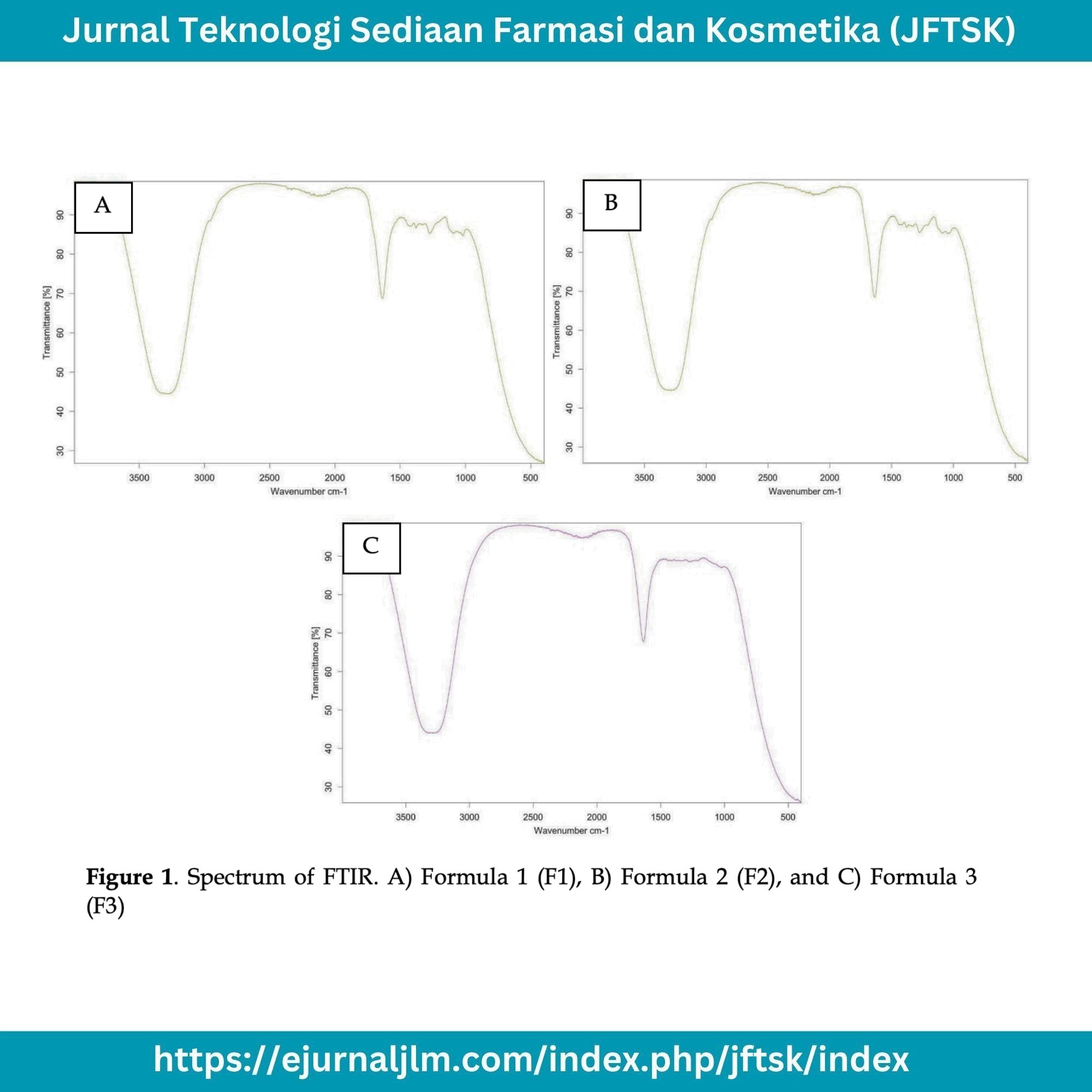
Hydrogel is a hydrophilic material that can absorb and retain large amounts of water through the formation of hydrogen bonds between polymer functional groups to form a stable three-dimensional network. The physicochemical characteristics of hydrogels are greatly influenced by the cross-linking process that determines the network density and stability of the preparation. This study aims to determine the effect of variations in the concentration of tannic acid as a chemical crosslinker on the physicochemical characteristics of polyvinyl alcohol (PVA)-chitosan-based hydrogels. Hydrogels were formulated with varying concentrations of tannic acid of 1%, 3%, and 5%, then evaluated including organoleptic tests, pH, viscosity, spreadability, adhesion, swelling index, irritation test, and characterization using Fourier Transform Infrared (FTIR). The results showed that increasing the concentration of tannic acid caused the formation of a denser hydrogel network, which was characterized by a decrease in the swelling index value and an increase in adhesion and changes in viscosity. The pH values of all formulas were within the physiological pH range of the skin. Irritation tests on 20 panelists showed that all formulas did not cause irritation reactions. FTIR analysis confirmed the presence of molecular interactions between PVA, chitosan, and tannic acid through hydrogen bond formation. Overall, variations in the concentration of tannic acid as a chemical crosslinker affected the physicochemical characteristics of the PVA–chitosan hydrogel and resulted in stable preparations with good quality
Downloads
References
Depkes RI. Farmakope Indonesia. Edisi VI. Jakarta: Departemen Kesehatan Republik Indonesia; 2020.
Mahamoud MM, Ketema TM, Kuwahara Y, Takafuji M. Enhancement of mechanical properties of benign polyvinyl alcohol/agar hydrogel by crosslinking tannic acid and applying multiple freeze/thaw cycles. Gels. 2024;10(8):527. doi:10.3390/gels10080527.
Zhou R. Multifunctional hydrogel based on polyvinyl alcohol/chitosan/metal polyphenols for facilitating acute and infected wound healing. Int J Biol Macromol. 2024;269:126–138.
Bercea M. Recent advances in poly(vinyl alcohol)-based hydrogels. Polymers (Basel). 2024;16:1–36.
Yılmaz BD, Aydemir Sezer U, Sarı A, Yıldız A, Sezer S. Formulation and evaluation of PVA-based composite hydrogels: physicochemical, leachables, and in vitro immunogenicity studies. J Mater Chem B. 2025;13(3):469–481.
Jasrotia S, Gupta S, Kudipady ML, Puttaiahgowda YM. Development and characterization of chitosan–PVA–tannic acid film for extended shelf life and safety of food products. ACS Omega. 2025;10:19361–19378. doi:10.1021/acsomega.4c09964.
Feng C. Toxicity and biocompatibility of glutaraldehyde crosslinked hydrogels. Int J Biol Macromol. 2021;180:483–491.
Sahiner N. Effect of natural crosslinker concentration on swelling and mechanical properties of hydrogels. Mater Today Commun. 2023;36:106007.
Zhao H. Tannic acid as a versatile natural crosslinker and antioxidant in biomedical applications. Front Chem. 2022;10:942665.
Fan J, Yang H, Yang J, Peng M, Hu. Tannic acid-based multifunctional materials: a review. RSC Adv. 2020;10(14):8060–8073.
Karakuş NR, Türk S, Guney Eskiler G, Syzdykbayev M, Appazov NO, Özacar M. Investigation of tannic acid crosslinked PVA/PEI-based hydrogels as potential wound dressings with self-healing and high antibacterial properties. Gels. 2024;10(11):682. doi:10.3390/gels10110682.
Yu X, Huang J, Wu C, Zhang W. Biocompatible autonomous self-healing PVA-CS/TA hydrogels based on hydrogen bonding and electrostatic interaction. Sci Rep. 2025;15(1). doi:10.1038/s41598-025-85298-3.
Nurrahmi F, Siregar YI, Fransiska D. Production of basic material carrageenan hydrogel using polymer based polyvinyl alcohol (PVA). Mar Sci Dep. 2017;(1):1–10.
Yuandari E, Rahma RTA. Metodologi Penelitian dan Statistik. Jakarta: In Media; 2017.
Araújo F, et al. Effect of chitosan properties and dissolution state on solution rheology and film performance in triboelectric nanogenerators. Gels. 2025;11:523:1–19.
Zatalini DF, Hendradi E, Drake P, Sari R. The effect of chitosan and polyvinyl alcohol combination on physical characteristics and mechanical properties of chitosan-PVA-Aloe vera film. J Farm Dan Ilmu Kefarmasian Indones. 2023;10(2):151–161. doi:10.20473/jfiki.v10i22023.151-161.
Chen C, Yang H, Yang X, Ma Q. Tannic acid: a crosslinker leading to versatile functional polymeric networks: a review. RSC Adv. 2022;12:7689–7711. doi:10.1039/d1ra07657d.
Werawati A, et al. Sediaan hidrogel ekstrak etanol daun kelor. Edu Masda J. 2024;8(2):119–130.
Sa’diyah A, Pambudi DB. Evaluasi sediaan masker hidrogel ekstrak etanol daun mangrove merah (Sonneratia caseolaris Engl.). Benzena Pharm Sci J. 2024;3(1):62–71.
Wahidah S, Ayu G, Saputri R. Formulasi dan uji stabilitas sediaan gel ekstrak etanol daun asam jawa (Tamarindus indica L.) dengan variasi gelling agent. J Mandala Pharmacon Indones. 2024;10(2):508–518.
Saarai A, Kasparkova V, Sedlacek T, Saha P. On the development and characterisation of crosslinked sodium alginate/gelatine hydrogels. J Mech Behav Biomed Mater. 2013;18:152–166. doi:10.1016/j.jmbbm.2012.11.010.
Diao Z, Li L, Zhou H, Yang L. Tannic acid and silicate-functionalized poly(vinyl alcohol)–hyaluronic acid hydrogel for infected diabetic. Regen Biomater. 2024;11:1–13.
Chen Y, Etxabide A, Seyfoddin A, Ramezani M. Fabrication and characterisation of poly(vinyl alcohol)/chitosan scaffolds for tissue engineering applications. Mater Today Proc. 2023. doi:10.1016/j.matpr.2023.02.303.
Gong Y, Chen X, Wu W. Advances in sample preparation: application of Fourier transform infrared (FTIR) spectroscopy in sample preparation: material characterization and mechanism investigation. Adv Sample Prep. 2024;11.
Zou X, Huang J. Hydrogen bond-regulated rapid prototyping and performance optimization of poly(vinyl alcohol)–tannic acid hydrogels. Gels. 2025;11:602.
Hong F, Qiu P, Wang Y, Ren P, Liu J, Zhao J, et al. Food Chemistry : X Chitosan-based hydrogels : From preparation to applications , a review. Food Chem X [Internet]. 2024;21(8326):101095. https://doi.org/10.1016/j.fochx.2023.101095
Alfuraydi RT, Al-Harby NF, Mohamed NA, Alminderej FM, Elmehbad NY. Poly (Vinyl Alcohol) Hydrogels Boosted with Cross-Linked Chitosan and Silver Nanoparticles for Efficient Adsorption of. gels. 2023;9(882):1–25.
Liu R, Zhang J, Zhang T. Tannic acid–chitosan–PVA hydrogels with improved mechanical and antibacterial properties. Carbohydr Polym. 2020;247:116689.
Downloads
Published
How to Cite
Issue
Section
License
Copyright (c) 2026 Nana Nurindah Upara, Muhammad Taupik, Multiani S Latif, Nur Rasdianah, A. Mut’hi Andy Suryadi

This work is licensed under a Creative Commons Attribution-ShareAlike 4.0 International License.