Evaluation of Physical Stability of Carbopol Gel Containing Curcumin under Temperature Variations
DOI:
https://doi.org/10.70075/jftsk.v3i2.307Keywords:
curcumin, carbopol gel, physical stability, temperature, anti-inflammatoryAbstract
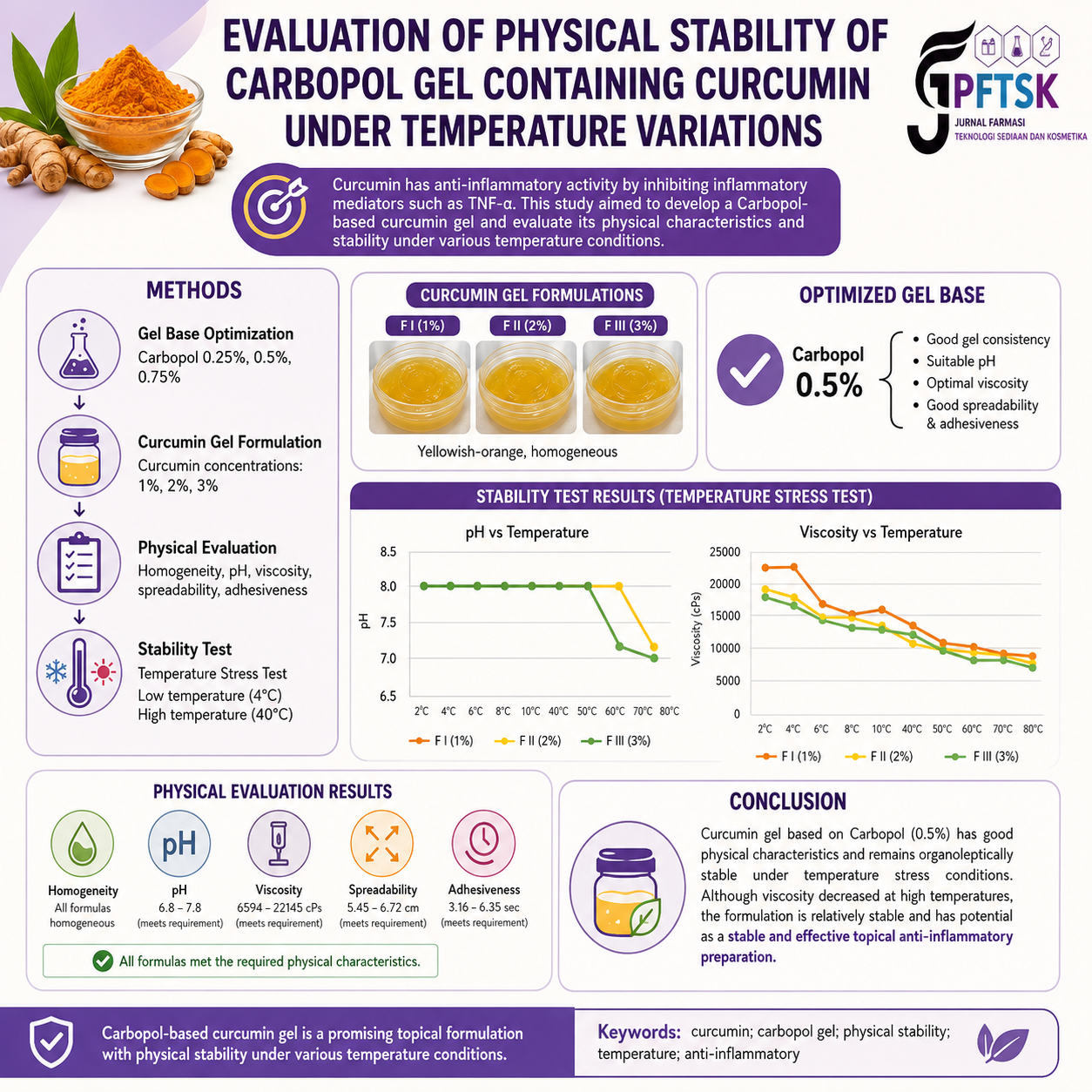
Inflammation is a biological response to tissue damage characterized by swelling, redness, pain, and increased local temperature. Curcumin is known to possess anti-inflammatory activity by inhibiting inflammatory mediators such as tumor necrosis factor-alpha (TNF-α). This study aimed to develop a Carbopol-based curcumin gel formulation and evaluate its physical characteristics and stability under various temperature conditions. This research employed a laboratory experimental method including gel base optimization, formulation of curcumin gel with concentration variations (1%, 2%, and 3%), physical evaluation, and stability testing using a temperature stress test at low and high temperatures. The results showed that Carbopol 0.5% was the optimal gel base. All formulations met the required physical characteristics, including homogeneity, pH, viscosity, spreadability, and adhesiveness. Stability testing indicated that the formulations were organoleptically stable and relatively stable chemically, although viscosity decreased at higher temperatures. Therefore, Carbopol-based curcumin gel has potential as a stable and effective topical preparation.
Downloads
References
S. S. Suryandari, E. De Queljoe, and O. S. Datu, “Anti-Inflammatory Activity Test Of Ethanol Extract Of Sesewanua Leaves (Clerodendrum Squamatum Vahl. ) Towards White Rats (Rattus Norvegicus L.) Induced By Carrageenan,” Pharmacon, vol. 10, no. 3, pp. 1025–1032, 2021.
R. Artasya and S. A. Parapasan, “Jahe Sebagai Antiinflamasi,” J. Penelit. Perawat Prof., vol. 2, no. 3, pp. 309–316, 2020.
L. N. Syamsi, Syamsudin, E. Mumpuni, W. Widowati, O. Nursanti, and R. Qodriah, “Analisis In Silico Senyawa Curcuma xanthorrhiza dan Moringa oleifera sebagai Kandidat Antiinflamasi,” J. Syifa Sci. Clin. Res., vol. 7, no. 1, pp. 57–66, 2025.
F. R. T. Agustiani, L. R. Sjahid, and F. K. Nursal, “Kajian Literatur : Peranan Berbagai Jenis Polimer Sebagai Gelling Agent Terhadap Sifat Fisik Sediaan Gel,” Kaji. Lit. Peran. Berbagai Jenis Polim. Sebagai Gelling Agent Terhadap Sifat, vol. 7, no. 4, pp. 270–287, 2022.
N. A. Thomas, M. Taupik, E. N. Djuwarno, R. P. Papeo, and N. N. Djunaidi, “Uji Penyembuhan Luka Bakar Gel Enzim Bromelin Menggunakan Carbopol 940 Secara In Vivo,” vol. 5, pp. 232–244, 2023.
R. Suharsanti, C. Astutiningsih, and N. D. Susilowati, “Secara KLT Densitometri Dengan Perbedaan Metode Ekstraksi Curcumin Levels From Turmeric Extract (Curcuma Domestica)” J. Wiyata, vol. 7, no. 2, pp. 85–93, 2020.
W. F. Yanti, “Kurkumin Pada Rimpang Kunyit Identification And Determination Of Curcumin Compound Levels On The Turmeric,” vol. 16, no. 2, pp. 48–52, 2019.
S. L. Latifah, Pudjono, and R. F. Rosmi, “Formulasi dan evaluasi mutu fisik sediaan body scrub cream varietas ubi jalar dalam fase air dan minyak formulation and physical quality evaluation of the preparation of body scrub cream variety of sweet potatoes in water and oil phase,” Pharm. Perad. J., vol. 2, no. 1, pp. 20–32, 2022.
M. A. Paneo, N. A. Thomas, M. S. Latif, T. S. Tuloli, and S. D. M. Nurkamiden, “Formulasi dan Karakterisasi Fisik Sediaan Emulgel Facial wash dengan Menggunakan Kombinasi Minyak Almond (Prunus amygdalus dulcis) dan Surfaktan Sodium Lauryl Sulfate,” J. Pharm. Sci., vol. 8, no. 2, pp. 1318–1327, 2025, doi: 10.36490/journal-jps.com.v8i2.640.
M. Multiyana and W. Wuryandari, “Mutu Fisik Body Scrub Rimpang Kunyit (Curcuma domestica Val.) sebagai Antioksidan,” Akad. Farm. putra Indones., pp. 1–10, 2018.
Á. L. Santana and M. A. A. Meireles, “Thin-Layer Chromatography Profiles of Non-Commercial Turmeric (Curcuma longa L.) Products Obtained via Partial Hydrothermal Hydrolysis,” Food Public Heal., vol. 6, no. 1, pp. 15–25, 2016, doi: 10.5923/j.fph.20160601.03.
A. Munthe, A. Sartika Daulay, and A. Fithri Pulungan, “Journal of Pharmaceutical and Sciences Determination of Rhodamine B Levels in Seasoning Powder Using TLC and HPLC Methods Penetapan Kadar Rhodamin B Pada Bumbu Tabur Dengan Metode KLT Dan KCKT,” Jps, vol. 2025, no. 2, pp. 642–652, 2020, [Online]. Available: https://doi.org/10.36490/journal-jps.com.v8i2.845
A. Sumule, I. Kuncahyo, and F. Leviana, “Optimasi Carbopol 940 dan Gliserin dalam Formula Gel Lendir Bekicot (Achatina fulica Ferr) sebagai Antibakteri Staphylococcus aureus dengan Metode Simplex Lattice Design” vol. 17, no. 01, pp. 108–117, 2020.
K. A. Suryadewi, “Optimasi Jumlah Karbopol 1 , 5 %, Triethanolamine , dan Air terhadap Sifat Fisik Emulgel Astaxanthin dan Ekstrak Wortel dan vitamin C” OBAT J. Ris. Ilmu Farm. dan Kesehat., vol. 3, pp. 266–287, 2025, [Online]. Available: doi: https://doi.org/10.61132/obat.v3i4.1558
St.Rahmatullaha, Slamet, W. A. Ningrumb, and N. K. Dewi, “Formulasi Dan Evaluasi Sediaan Gel Hand Sanitizer Sebagai Antiseptik Tangan Dengan Variasi Basis Karbopol 940 Dan Tea,” CHMK Pharm. Sci. J., vol. 3, pp. 189–194, 2020.
W. Rahmadani and F. Amelia, “Optimasi Sifat Fisik Gel Variasi Konsentrasi Lidah Buaya Dan Karbopol 940 Dalam Pembuatan Basis Gel,” J. Pendidik. dan Sains, vol. 5, no. September 2025, pp. 2401–2410, 2025.
A. I. Suryani, K. D. M. Buana, N. P. I. P. Shantyoga, N. L. E. Desriati, and M. Faisal, “Carbopol-Based Clove Oil (Syzygium aromaticum) Emulgel: Formulation, Physical Characterization, and Thermodynamic Stability,” J. Syifa Sci. Clin. Res., vol. 7, no. 3, pp. 340–350, 2025.
A. F. Tsabitah, A. K. Zulkarnain, M. S. H. Wahyuningsih, and D. A. A. Nugrahaningsih, “Optimasi Carbomer, Propilen Glikol, dan Trietanolamin Dalam Formulasi Sediaan Gel Ekstrak Etanol Daun Kembang Bulan (Tithonia diversifolia),” Maj. Farm., vol. 16, no. 2, p. 111, 2020, doi: 10.22146/farmaseutik.v16i2.45666.
W. Firmansyah, G. S. Agustien, and N. N. Fadilah, “Formulasi Dan Uji Stabilitas Fisik Sediaan Masker Gel Peel-Off Ekstrak Etanol Umbi Porang (Amorphophallus Muelleri) Sebagai Antioksidan,” J. Ilmu Kesehat. dan Kedokt., vol. 1, no. 4, pp. 47–59, 2023.
S. Diba, A. A. A. D, M. A. Thaha, N. Nopriyati, S. Kartowigno, and S. Budiamal, “Perawatan Kulit Anak Dengan Dermatitis Atopik,” Media Dermato-Venereologica Indones., vol. 49, no. 1, pp. 57–63, 2022, doi: 10.33820/mdvi.v49i1.362.
N. N. Fitri, N. Rusdiana, and L. O. A. Rasydy, “Kandungan Metilparaben Dan Propilparaben Dalam Krim Wajah Yang Beredar Di Wilayah Labuan Kabupaten Pandeglang,” J. Ilmu Farm. dan Farm. Klin., no. 1, pp. 88–95, 2024, doi: 10.31942/jiffk.v2i1.9113.
K. Rohilla, S. Ahlawat, M. Choudhary, and V. Budhwar, “A comprehensive review on physicochemical, pharmacological and analytical profile of curcumin,” J. Res. Pharm. Sci., vol. 2, no. 12, pp. 987–998, 2021, doi: 10.26452/ijrps.v12i2.4614.
W. E. Soliman, T. M. Shehata, M. E. Mohamed, N. S. Younis, and H. S. Elsewedy, “Enhancement of curcumin anti-inflammatory effect via formulation into myrrh oil-based nanoemulgel,” Polymers (Basel)., vol. 13, no. 4, pp. 1–16, 2021, doi: 10.3390/polym13040577.
L. Deleebeeck et al., “Unified pH Measurements of Ethanol, Methanol, and Acetonitrile, and Their Mixtures with Water Lisa,” Sensors, pp. 1–16, 2021.
S. Wahidah, G. Ayu, and R. Saputri, “Formulasi dan Uji Stabilitas Sediaan Gel Ekstrak Etanol Daun Asam Jawa (Tamarindus indica L.) dengan Variasi Gelling Agent,” J. mandala pharmacon Indones., vol. 10, no. 2, pp. 508–518, 2024.
L. Pavčnik, M. Prunk, T. Trdan Lušin, and R. Roškar, “Accelerated Predictive Stability Testing: Accelerating Registration Phase and Application of Reduced Designs for Shelf-Life Determination of Parenteral Drug Product,” Pharmaceutics, vol. 17, no. 2, pp. 1–17, 2025, doi: 10.3390/pharmaceutics17020160.
J. Susilo and A. Febriana, “The Effect of Olive Oil Concentration in Lip Balm on The Physical Properties and The Product Acceptance Rate,” Indones. J. Pharm. Nat. Prod., vol. 5, no. 1, pp. 28–34, 2022, doi: 10.35473/ijpnp.v5i1.1556.
H. Mehdi-Sefiani, E. Chicardi, A. Romero, and V. M. Perez-Puyana, “Unveiling the Impact of Gelation Temperature on the Rheological and Microstructural Properties of Type A Gelatin Hydrogels,” Polymers (Basel)., vol. 16, no. 13, 2024, doi: 10.3390/polym16131842.
Downloads
Published
How to Cite
Issue
Section
License
Copyright (c) 2026 Najwa Athifah Tsamarah Umar, Mohamad Aprianto Paneo, Nurain Thomas, Fika Nuzul Ramadhani, Lisa Efriani Puluhulawa

This work is licensed under a Creative Commons Attribution-ShareAlike 4.0 International License.